



Help Wanted:

The Goods Mart is hiring a Buyer / Wholesale Manager in Brooklyn.
You’ll source the next generation of emerging food & beverage brands while helping grow our retail, corporate pantry, hotel, and wholesale business.
Details + apply:
https://www.thegoodsmart.com/pages/the-goods-mart-buyer-wholesale-manager-emerging-brands
Grocery Nerds Podcast Is LIVE!

New Episodes Weekly!
Feature: Class War Smoothies.
By Errol Schweizer
Prologue. Los Angeles Is Still Burning.
Los Angeles is a mess. I love/hate the City of Angels. Sunshine, homeless camps, ocean breezes, catastrophic wildfires, highway gridlock, shiny new subways, Beverly Hills, dollar stores, Erewhon. Fucking LA.
I read a lot about LA when I was younger, that far way place where some of my favorite bands came from. I imagined it must have been real fucked up to produce Black Flag, Cypress Hill, Body Count, Slayer, Pennywise, NWA, Bad Religion, Fishbone, Social Distortion and their themes of violence, alienation, struggle, existential angst, detached cynicism. Cheery stuff.
Mike Davis was my real entry point to thinking critically about LA, back when I was a provincial Bronx boy who had never been west of Toronto, back before I went to Expo West in Anaheim every March. Davis, the sturdy Irish California truck driver, champion of the underdog, cultural critic and working class scholar, who over the course of many books and scholarly works broke down the raging inequities, institutional racism, oppressive architecture and fragile ecosystems behind the sun-kissed glitz and glamour, who wrote about letting Malibu burn, prescient and unyielding, discomfiting, and also told the stories of the courageous locals who pushed back to make the City of Angels, and the world, more fair and just.
I once had dinner at Davis’ home. A grad student friend of mine invited myself and my girlfriend (and future wife) to hang out. Davis showed off his big Toyota pickup truck and held court with grad student acolytes gathered around in a semi-circle. His wife served us dinner and washed the dishes, cleaning up after all of us. My Riot Grrl partner was not having it. I never heard the end of it. Never meet your heroes, right? I still love his books, City of Quartz and Ecology of Fear are always on my shelf, Magical Urbanism and Prisoners of the American Dream still brilliant.
Davis died a few years back. RIP, bro, next time I’ll just do your dishes. I wonder what he would think about the food industry today, the union drives in meat packing and grocery, about food prices, food processing and MAHA. That would be a fun conversation. I wonder what he thought when he went to local grocery stores, and how he would frame retail in the context of the brutal LA he documented throughout his life. Maybe grocery is too provincial for a global thinker like Mike Davis. Mike Davis at Erewhon. That would have been a fun read.
Nowhere, Backwards.
Produce is pristine. The mangos are stacked and placed perfectly by skilled produce lifers. The $10 cartons of regenerative organic strawberries from the Ecology Center nested gently side by side, a bit out of my price range. The wet rack is freshly misted and rotated, the peppers stacked in rainbow slanted columns, chards and collards upright, stems down, standing like enormous fronds waiting to be grazed. Cut fruit, packed in house, prices obscene, the freshness, brix and quality indisputable, fruit institutionally purchased for immediate consumption, not just cut from culls. Jet set asparagus flown in and stacked vertically, Michael Pollan’s annoyance, his framing of everything wrong with retail foodie culture. Yet here we are. But this isn’t Whole Foods. We’re nowhere, backwards.
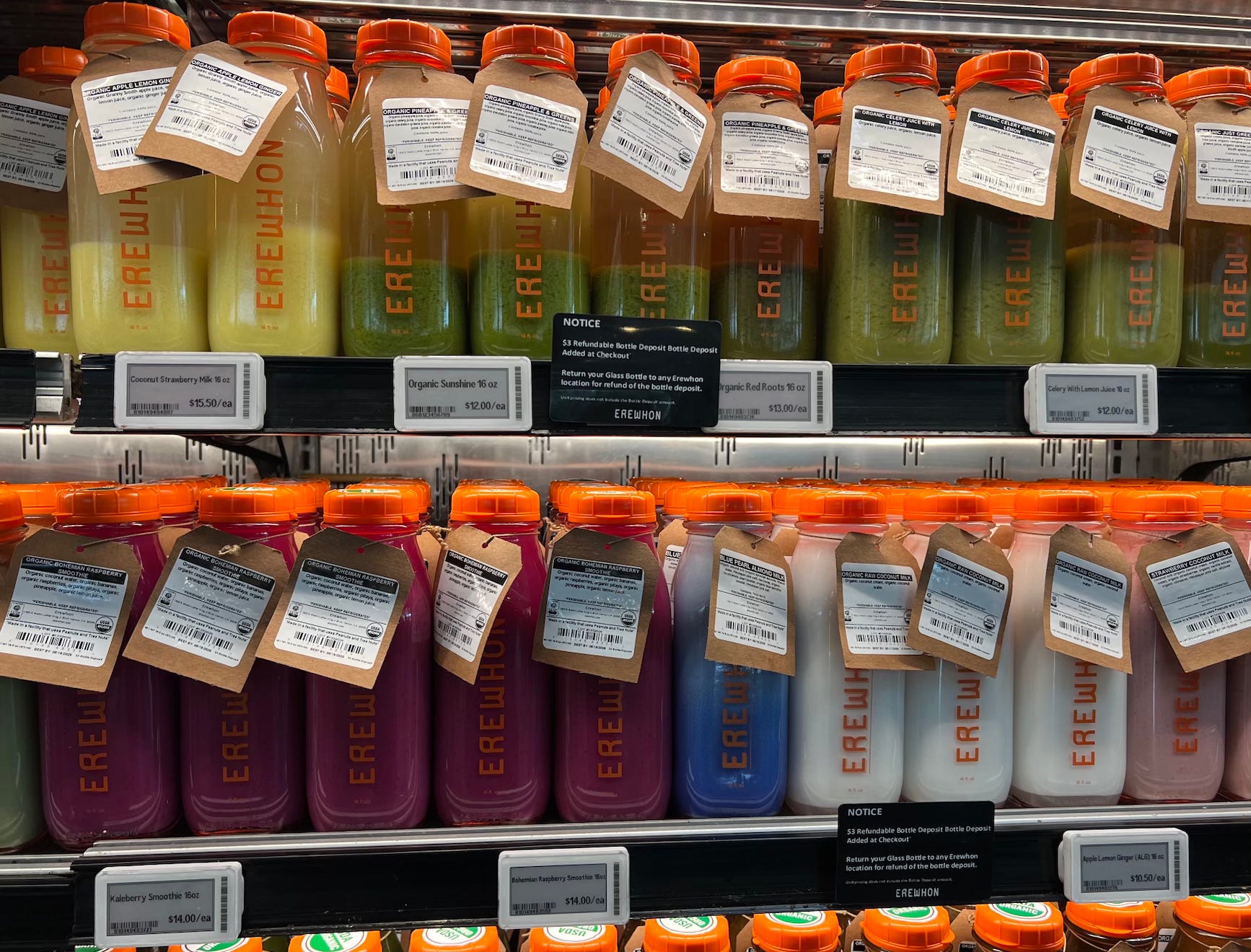
No plastic for fresh made smoothies and juices. Glass bottles, filled to the rim with beet, celery, lime, apple, ginger, that blue stuff that settles to the bottom. I feel healthier by osmosis.
Around the corner from the registers, a run of chocolate bars, organic, regenerative, fair trade, direct trade, bean to bar, slave labor free, no Hershey’s, Cadbury, Mars, snacks for $6, $7, $12 a bar. Choose wisely, it’s not a snack, it’s an investment.
The floors are spotless. You could eat off the damn floors. I don’t. This is just hypothetical.
The health and beauty aids department is oversized, vast, an austere apothecary, a bit precious and dry, but intensely category managed and plannogrammed. Dense with bottles, wooden shelves, mason jars, lotions, potions, free range snake oils. Private label dominates the sets, a smattering of national brands accented by higher efficacy labels typically just found in your chiropractor’s office, your naturopath’s pills of choice, a step beyond the generics and mainstream labels and questionable shit you just ordered from Amazon. Thorne, for instance.
There is a consideration to the assortment strategy, attempting to justify the high prices and higher margins with the best products buyers can source. It’s more or less a true cost passed through to customers, plus a handsome profit. It’s obvious to those in the know, alienating to the price sensitive or folks who just aren’t committed to the lifestyle, and a clear status threshold for those willing and able to pay for such outsourced, privatized healthcare. Should all of this only be for the well-healed/well-heeled?
Despite the social media virality of $30 smoothies, the bulk of the store is just like the bulk of any grocery store interested in staying afloat: several hundred linear feet of packaged food aisles. The frozen, ambient, refrigerated, fast moving consumer goods stocked by experienced, skilled laborers. Products that provide the high turns, modest margins, high sales and repeat purchases that pay to keep the lights on. It’s a bit beyond the sku rationalized, national brand focused, private label heavy Whole Foods or Sprouts assortment. More small and medium sized brands. Weird shit, new product award winners from every recent trade show, Shark Tank, Pitch Slam heavyweights, minority and women owned businesses well beyond the minimum ESG ratings requirements.
Piles of plant based, organic, regenerative, non gmo, sustainable, humane, all natural, biodynamic, gluten free, Mediterranean, Blue Zone, ketogenic, mythologized Paleolithic diets for your inner hunter-gatherer mistakenly trying to avoid refried beans and tortilla chips, and all the better for you, clean labels, GLP-1 friendlies for your wearables.
And $20 bottles of water.
Tight plannograms, shelves faced, fronted, rotated, packed out by an invisible army of clerks, products segmented by price point, attribute, purchase occasion, brand, and not just helter skelter thrown together for the Haylie and Hallie and Kylie and Timothee crowd pushing carts in the aisles. Plannograms with, to be fair, minimal entry level price points, but otherwise more than adequately following the rules of assortment planning and visual merchandising. Pricey as hell, but interesting, dense to the point of over-saturation and very astutely built to maximize spend and basket size.
The plant-based beverages set, case in point. Bottom shelf, mass market brands, entry-ish level price points for the well-healed discerning shopper, Oatly and So Delicious. Next shelf up, Three Trees Organic bottles, a whole shelf, mid-premium pricing. Then, Califia Farms, odd shaped bottles, a full shelf of a best-selling brand launched as a Whole Foods exclusive in 2013. Above that, aseptic boxes of pecan, almond, cashew, coconut, oat, barista blends, New Barn, Elmhurst brands, premium price tiers at or above eye level. Malk above that fray, most of a shelf, with more Califia creamers, then a top shelf of more plant based creamers, not a cow in sight, probably a little heavy on the guar, carob bean and xanthum, but what’s a little gum Arabic between friends? A little stomach upset beats heart disease. If this was the plant-based Olympics, we’d have a triple crown winner, a vegan hat trick, an animal free icon, an incipient Plant Based Beverage Trade Association. It’s a work of art.
Aisle by aisle, it’s a consistently heavier, denser than average specialty assortment a la Central Market and correspondingly higher price points, contrasted downstream with Whole Foods, who is now stealing share from Kroger and Target. But nowhere, backwards, is gunning for that Bieber and Jenner level wallet share, the yoga and pilates crowd, the folks with disposable incomes trying to eat healthier and more adventurously, those forming the K shape summit, premium as fuck. Pristine. Not an item out of place, during a busy weekday lunch rush, the operational quality control by that army of quiet, busy clerks, relentless in their retail perfection, and rarely credited in real time.
The clerks and servers in prepared foods are even busier. The deli cooler is packed, faced, fronted with glass mason jars of soup, chili, bone broth, stock, mostly organic, ridiculously fresh, Just oh my god don’t look at those prices. 32oz chicken rice, chicken barley, chicken noodle, likely cooked last night, chilled and sealed, $16.50 a jar, 50-60% gross margins, I can’t imagine the shrink, but the stuff is selling, even as I am standing there, in the way. Fresh hot sauces, salsas, pickled onions, jalapeños, pestos, all private labeled, the logos oriented vertically, austere, high touch in its simplicity. A row of fresh packed salads, a cooler of chilled sides and dips. All neat, clean, bright.
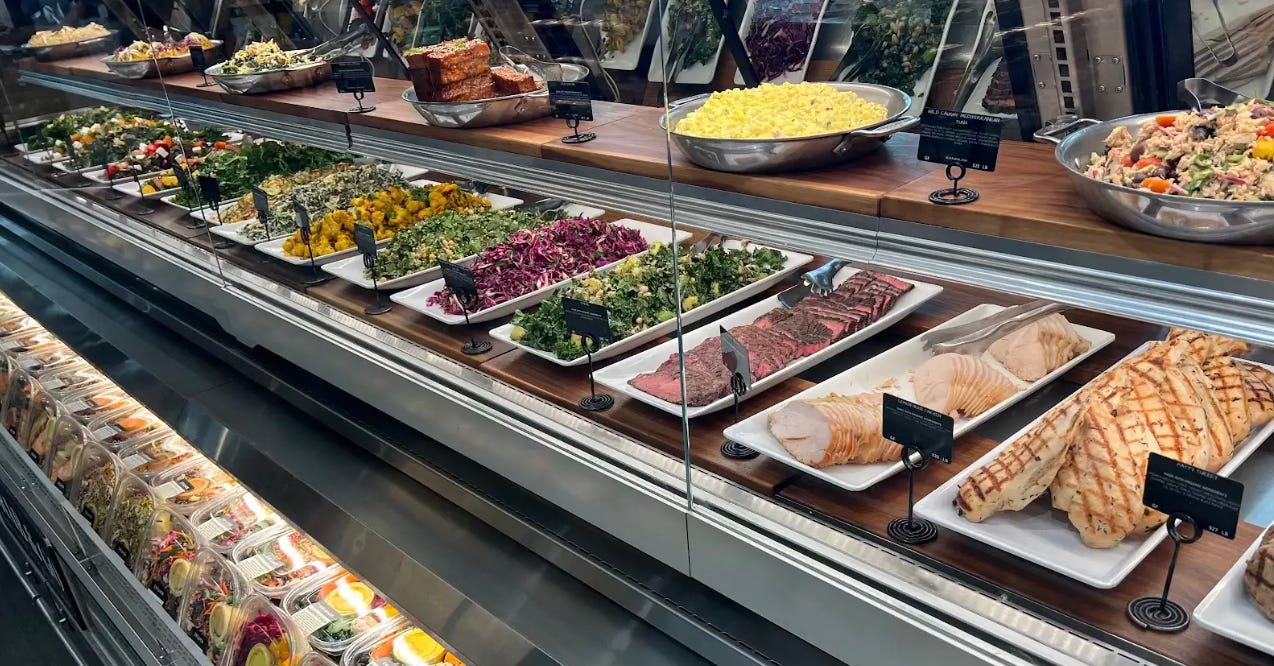
Grab and go is off the charts price wise. I’ve never spent $35 a plate for grocery store takeout, are they out of their damn minds? The assortment is, once again, pristine. Organic, lots of locally grown, freshly made… no literally, you can watch them making it all, you can smell the vegetables searing, the meat grilling, the sesame oil smoke points, the seasonings. Vegetables, grains, stir fries, sides, mains, proteins, grilled, roasted. $35 a plate. Hell, tack that to the starting hourly wage.
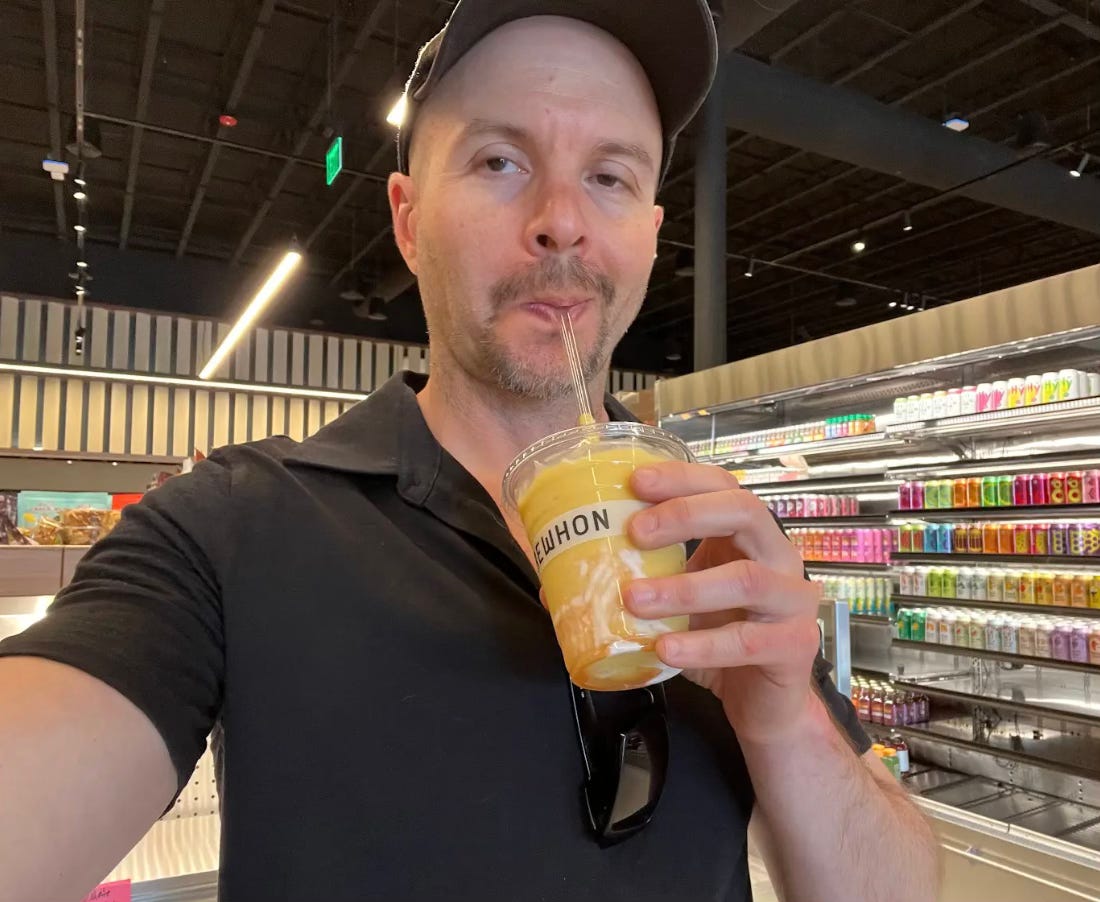
I wouldn’t bother with the smoothies. It’s a meme at this point, do I need to even?
So they gave me one for free. It was tasty. But too sweet, too cold, it gave me a headache.
I’m too old for this shit.
My hosts and tour guides likely sensed my crankiness, judging, scowling, feeling a bit rammy with the pricing and ultra-premiumness, skeptical of the preciousness.
So they fed me, on the house.
The food service staff was friendly, efficient, helpful, enthusiastic, like they still wanted to be here, busily serving up the bountiful, steaming hot plates worth their weights in gold. The math here was wild. $35 a plate, handsomely piled with easily $10-12 in ingredients of the highest spec, $10-15 in skilled labor of cooks and sous chefs, plus overhead, and likely $5-8 in pure profit per plate. Investors priapic for every fiscal quarter earnings report.
Yeah, it was really good. Too good for grocery takeout.
Is this a conflict of interest? Bribed with a $35 plate of steamed fish and grilled veggies? Should I now feel entitled?
And yet, everyone should be.
Maybe this nowhere, backwards should be for everyone, if they want it, not only for the most deserving, endowed, the entitled, the uncouth masses never beneath such quality.
There’s this tendency to assume working people, the working class, the working poor only want to eat shit, that their choices limited by income, geography, upbringing, education are not reified and eternal but existential, this assumption itself laced with cognitive biases from the professional classes, the bias of the ultra-processed averse and austerity minded RFK MAHA crowd that thinks SNAP subsidies encourage junk food consumption despite ample data showing otherwise; the bias of the food as medicine crowd that prescribes healthier options as if choices like that are not proscribed by income, geography, education, upbringing, peer pressures ; the bias of nutritionists, dietitians and food scientists who are religiously committed to an instrumentalist paradigm of recommended daily allowances and serving sizes regardless of product sourcing, quality and attribution; the bias of food security advocates who passionately extol the ethics of repurposing food waste as food for the poor, the lesser quality garbage rejected by Whole Foods and Kroger that is destined for the landfill because it’s damaged, old, short dated, overstocked, undersold, unloved, yet somehow is still good enough for the have-nots, even if it wasn’t good enough for retail, for the 10% driving 50% of consumption, for the Timothees and Kylies.
Because in the end, everyone loves telling the working poor, the working class what to eat. All of y’all. All of yous. All of us.
Why not public luxuries instead?
Why should entitlements be the lowest common denominator?
Can Good Food feed the world, if the world wants it?
And why not redistribute the health? If Bieber, Jenner, Kardashian can afford it and enjoy it, then so should anyone that wants it (and it’s really ok not to want it too, it’s really a bit much sometimes). In the end it’s about agency, choice, access to the best as a fundamental right. Happiness. Health and wealth.
Redistribute the health.
Voucher up a free plate for every $35 plate sold, like a Thrive market model, a buy one, give one program, where the well-healed/well-heeled can purchase a meal or two that can be passed forward to anyone who can’t plunk down $35 for lunch, a Solidarity supply chain like the Solidaire markets in Quebec. Or carve out a portion of the annual enterprise EBIDTA for food access and food justice, either to support local organizations tackling food apartheid or investing in donating meals to organizations serving the working poor, the unhoused and indigent. And put real resources aside to lobby to reform SNAP to actually cover prepared foods; it’s an accident of history, in service of the BIG CPG ultra-processors and grain merchants, cognitive policy dissonance that feeds MAHA mythologies of how subsidies encouraging junk food consumption, a historical shortcoming that needs to be resolved, stat. Prepared hot meals for all.
Tack hourly employee starting wages to the price of a top-tier smoothie or freshly made hot meal, and only bring on full time hires. Don’t interfere in the inevitable union vote when sales slow down and employees want protection from the downsides, or better yet, when said employees inevitably wise up and get hungry for a bigger share of the upside, as they see the sales and profits continue to grow like roundup resistant amaranth weeds juiced up by their labor and efforts day in day out.
Carve out 30, 40, 49% of the enterprise as an ESOP, employee stock plans, make every clerk and cashier a millionaire, an aristocracy of labor, because health is wealth. So redistribute it.
Race y’all to the top.
If the yoga pilates trust fund upwardly mobile health conscious shiny happy people want their $30 smoothies, then let them, and the kids serving them up deserve job security, upward mobility and they damn better be making more than living wages to survive in Mike Davis’ and Body Count’s City of Angels.
Let the clerks have bread, the best damn bread, and roses too. Let them have nowhere, backwards.
Thanks to my friend and consigliere, the inimitable Mike Schall, for flying me out to LA, driving too fast in his Tesla and touring stores all day with me. Good times. More to come.
(perspectives are 100% our own and do not reflect sponsors.)
The best yet!
(1) Made me look up a word again (planogram). (2) "continue to grow like roundup resistant amaranth weeds..."! #chef'skiss (or the grocery equivalent.)