



1. New Expose on Dynamic Pricing.
2. New Podcast: Gross To Net.
Hosted by George Milton of Yellowbird Foods.
In this episode, Errol breaks down how Whole Foods industrialized better-for-you food at scale, the economics behind grocery pricing power, and why Walmart’s dominance shapes what gets grown and sold in America. He explains the math that drives food systems—from profit compulsion in publicly traded companies to the challenges of scaling regenerative agriculture—and makes the case for public grocery stores as a backstop to corporate food monopolies.
We dig into the uncomfortable truths about grocery margins, the difference between HEB and Kroger, why local food systems struggle to gain traction, and what it actually takes to operationalize the right to good food. Errol brings receipts on price gouging during COVID and explains why the middle of the food system—not farm-to-table movements or food tech—is where real change needs to happen.
If you want to understand how grocery actually works and what needs to change, this is essential listening.
3. Woodman’s Keeps The Promise.
(2025 Grocery Update Retailer of the Year).
The wife called me after 10:30pm on a weeknight. Pit stop on an evening road trip with a friend, to God-knows-where outside of Chicagoland. At a grocery store. Wife of Grocery Nerd, representing.
“Oh my God. They have 5 aisles of bread. This place is insane.” The wife had made it to Woodman’s.
Woodman’s. Regional icon. A century old. Employee-owned. Blue collar paradise.
200,000 square feet of full service supermarket magic, on the fringes of Chicagoland. A Wisconsin original, the pride of Janesville, a badger state icon.
“This place is soooo insane, you’ve never seen anything like it,” she said again and again as she and her friend roamed the aisles. Not even buying anything. Just vibing.
I had heard about Woodman’s a few years back, at a trade show dinner, when my old Whole Foods buddy John Davidowitz was slinging chewing gum. One of his John’s gum slinging colleagues, who was born and raised along the Ice Age Trail, gave us the lowdown on some of his favorite regional and independent grocery customers. Woodman’s, with their frequent pallet buys and massive promotional volumes and low, low prices, was at the top of the list.
“The place is wiiiiiild.” The wife Facetime’d me to show me what I was missing. Pallet drops of product everywhere, huge selection, endless aisles, stacked high and wide. Holding Walmart at bay, holding their own with other upstanding Midwest regional indies like HyVee, Schnuck’s, Festival. Cash/Debit only (or Discover card). Churning a couple million dollars a week out of each store, easily.
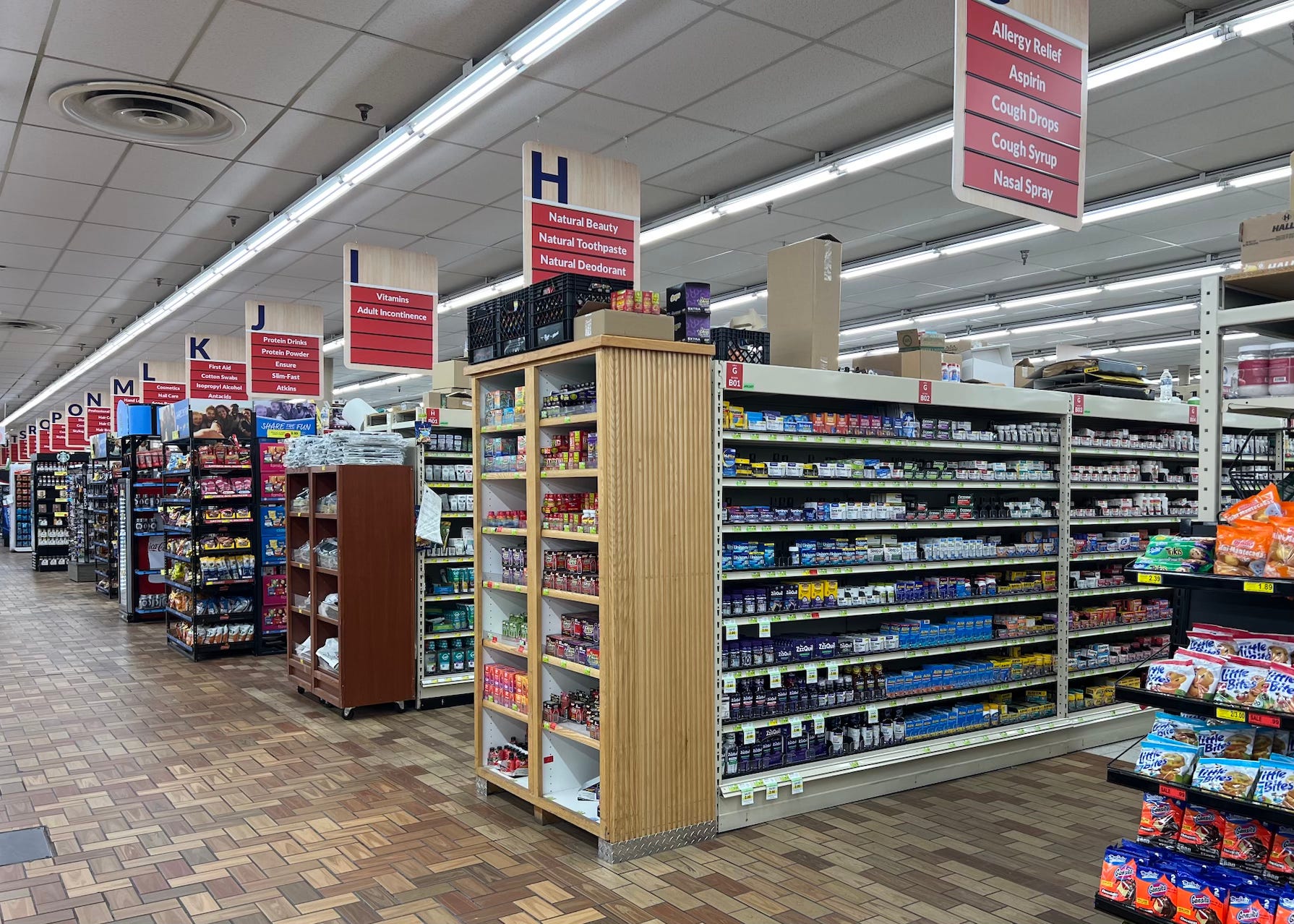
A couple weeks later, running errands north and west of Chicagoland, it was time for the brief detour up to the Woodman’s heartland of Southern Wisconsin. Up the interstate, endless glyphosatiated corn and soy fields among low rolling hills, cheap real estate dotted with massive fulfillment centers, logistics hubs, steely, steaming manufacturing facilities churning out Hormel chili, Frito Lay, Kettle Chips, Campbell’s Snacks, Claussen Pickles. Conagra frozen foods. Kerry Ingredients’ sprawling headquarters and a soon to be closed Treehouse Foods cookie facility for co-manufacturing, private labeling. Industrial food’s heartland. Woodman’s country.
But first, a grocery bedtime store.
Once upon a time, as the U.S. recovered from the horrors of World War Two, the publicly-funded infrastructure that fed all those troops overseas needed to be repurposed, sunk costs too great to be written off, profit potential to steep to be ignored. Combined with federal highways, home loans, GI Bills and subsidized subdivisions, the American supermarket industry as we know it was born, consumer outlets for the industrial food boom, packaged, processed, calorie dense essentials to be marketed to the masses by private corporations that would serve the common good, pay union wages and provide communities with cheap, convenient, abundant but not necessarily healthy or sustainable food while making investors ridiculously wealthy, to be the envy of the world, at least if we believed our own P.R. But somewhere along the way, supply chain disruptions, Just In Time inventory fiascos, 35% price inflation in under 6 years, tens of billions in shareholder dividends for ultra processed PepsiCo, Walmart, Mondelez, Kroger investors, with 47 million Americans skipping meals, and so, many grocers lost the script, forgetting the original promise of the industrial food supply. Cheap. Convenient. Abundant. The end. Now go to bed, dear hearts.
But not Woodman’s. Still at it. The industrial food heartland. Keeping the promise. Still cheap, convenient, abundant. Not necessarily healthy and sustainable, but so much of it, every day.
Yes, 5 aisles of bread. Uniform, consistent, neatly bagged in branded cello packaging.
The aisles had letters and numbers, or letters, or numbers. The bread aisles, B1-4, plus a row of freezers for frozen bread. Each sign labeled with the brands of bread therein. King’s Hawaiian, Aunt Millie’s, Village Hearth, Butternut, Country Hearth, Sara Lee, Pepperidge Farm, Beefsteak, Thomas’, Lakeland, Sunbeam. The major regional brands of mass manufacturers Flower Foods and Bimbo, who control majority of market share of bread sales nationally (Bimbo also a major snack and pastry maker, thank you, Takis). No artisanal, hearth-baked bread here. Just homogenized, bleached white flour, TBHQ, BHT, methylcellulose, azidocarbamide, corn syrup, dough conditioners, leavening agents, preservatives, ultra processed foods, Big Food, bread for the masses, 5 aisles of bread, followed by several low rise gondola aisles of carb-heavy pastries, croissants, roles, pretzel crackers, biscuits, pitas, pita chips, pit snacks, Entenmann’s, Hostess, meringues, plus dozens of pallet stacks of soft drinks, on deep discounts, stacked, 8, 9, a dozen cases high from Coke, Pepsi, Dr. Pepper, a vicarious diabetic coma coming on, thankfully broken up by a massive produce section.
Produce, leading with organic. And not small scale farmstead organic. Industrial organic. Organic for the masses. Sure, some locally grown stuff, too, cello wrapped. But at scale, and cheap. Same standards, just bigger, more consistent, more of it, telescoped out, reticulated, like a lesson in perspective drawing, the sight lines going up and out to an imagined horizon. Bagged in colorfully labeled cello for easy stocking and rotation. Apples, grannies, honeycrisps, galas, Fujis, cosmic crisps, cut in with mangos and pears, bags of potatoes and onions, the waxed cardboard cases colorfully labeled with brand names, distributors, packers, importers of record. A cooler of organic greens from California, celery, brassicas, plus local green beans, brussels, cilantro, lettuce and plastic tubs of salad greens and baby spinach. A wall cooler of hydroponic berries from Driscoll’s, the industry’s largest berry marketer custom-built to source from plantations around the world to ensure consistent daily supply of fresh but not necessarily the best tasting berries, without interruption, a miracle of modern refrigeration, logistics and lax trade and labor laws.
And beyond the stacks of industrial-strength organic, a few thousand square feet of conventional produce, stacked high, abundant and priced to sell through with minimal shrink. Produce square footage on par with HEB, Wegman’s or HyVee, but grittier, packed with customers. Bins of potatoes and sweet potatoes, onions and citrus, oranges, grapefruits, lemons, limes. Massive ambient bins and stacks of celery cauliflower, broccoli crowns, mustard greens collards, rutabagas, a statement of volume and sell through, priced at .89, .69, 1.19, 1.29, 1.39 a pound, not fucking around. A stack of ripe green avocados, cut in with a bin of red onions and shoppable pallet of Tostitos’ top sellers, guac and chips.
A row of coolers on the far wall, with all your favorite “BFY” beverages, the Olipops, Poppis, aloe, coconut waters, kombuchas, plus several doors of hummus and high pressure pasteurized guacamole, and a door of kimchi and krauts, even radish kimchi. Radish kimchi, at Woodman’s. Wild. A store that was so obviously focused on tonnage and sell through to cover those margins, which surely must be in the low 20’s on par with Walmart or Kroger, but still attuned enough to consumer trends and niche tastes -like mine- to stock two facings of bright red radish kimchi.
Going past a couple low rise aisles of packaged nuts and dried peppers, ambient, shelf stable grocery beckoned.
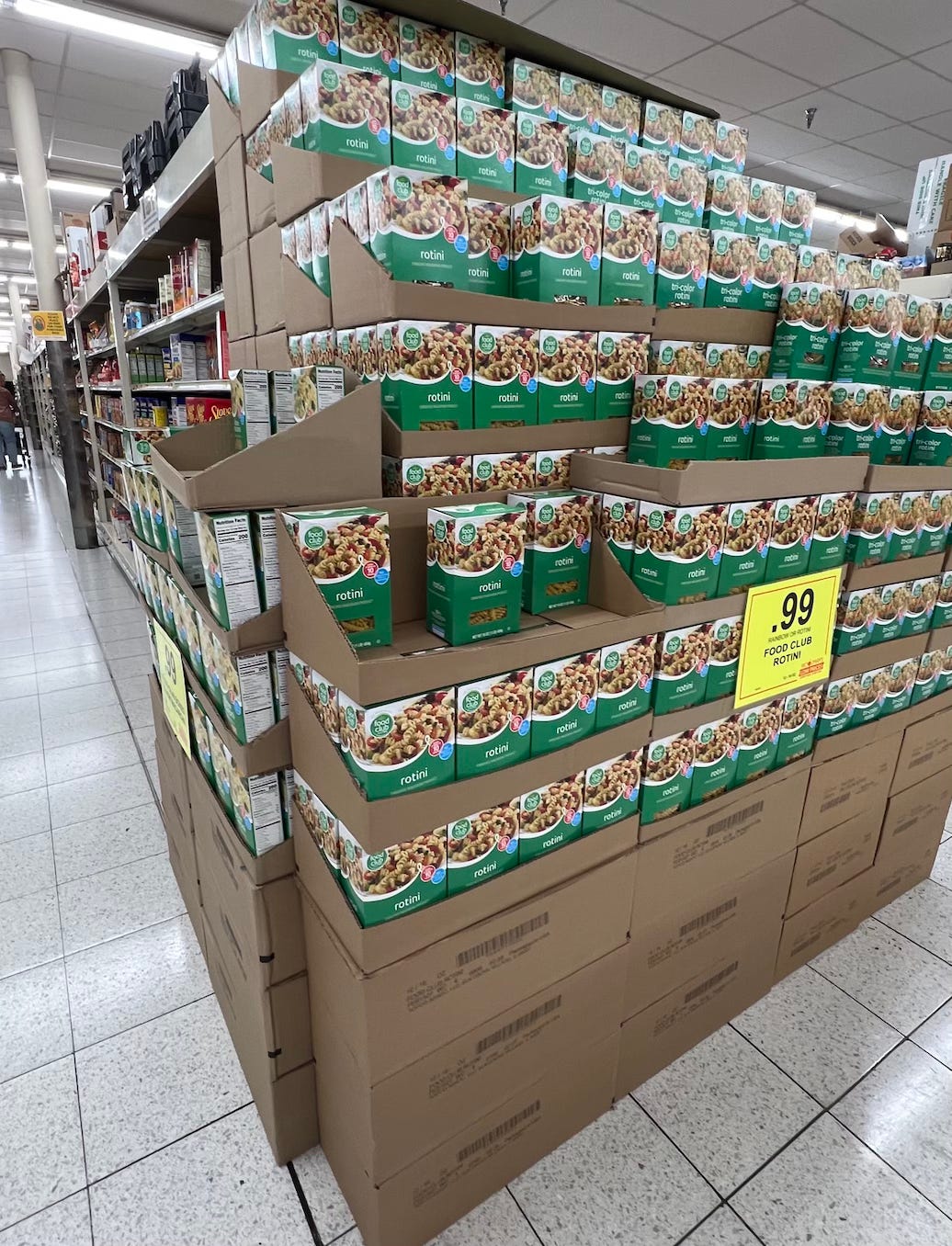
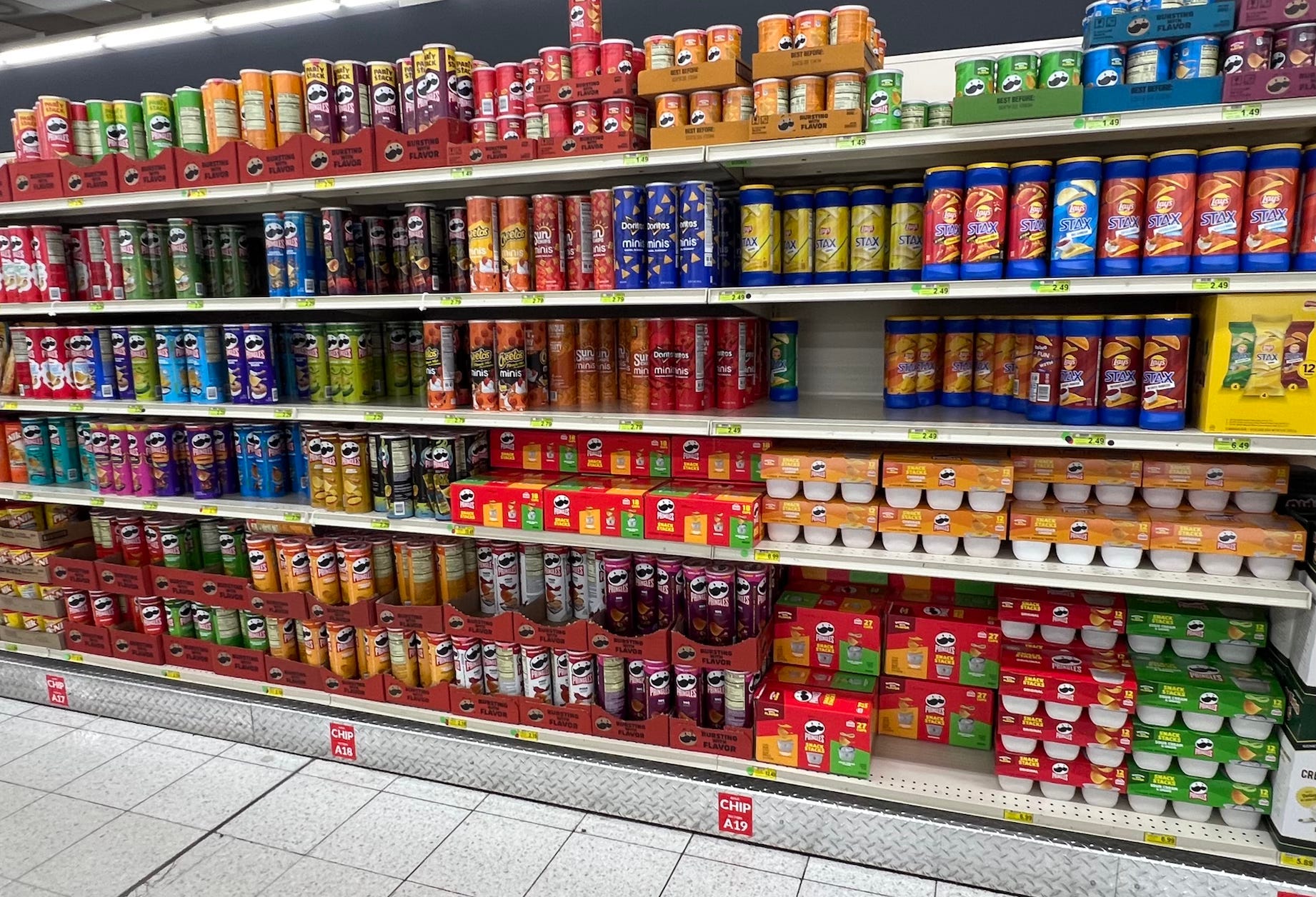
A wall of case stack displays, Sweet Baby Ray’s marinades, Heinz ketchup, French’s mustards, each stack over 10 cases high, 3 cases deep, 8 or 10 cases wide, easily 200 cases of product, or 2000 units, sitting there on sale at 2/$4, 2/$5, literally 1998 prices. Or the .99 a box Topco pasta, at least 300 cases of green boxes stacked nearly ten feet high in a roughly pyramidal shape reminiscent of a Teflon-dye cut Tenochtitlan. And the wall went on and on, transitioning to salty snack after salty snack, Takis to Pringles to popcorn to potato to tortilla to pretzel chip, all the way to a far wall that must have been nearly a quarter mile away, the wall of snacks and marinades facing aisle after aisle of packaged foods, each capped off with an endcap of cans, jars, bottles, stacked 10 cases high, 6 or 8 cases deep, 8 or 10 cases wide, easily 3000 units of product on each display over and over again for as literally as far as the eye could see, a small city of food, 200,000 square feet, almost four football fields of food. Cheap, convenient, abundant. Keeping the promise.
Flanking the condiment stacks and their throwback prices, were the paper goods aisles. Or to be more specific, aisles made of stacks of paper goods. Paper towels, toilet paper, Irresistible, Plenty, Bounty on top of Bounty, Scott, Fiora, Angel Soft, Viva, Cottonelle, quilted Charmin, stacked in rough pyramids 5 or 6 rolls high, 3 or 4 rolls wide, 3 rolls deep, all the way to what seemed like the front of the store a few hundred feet to my left.
The paper goods empire also marked a geographical boundary. Brown, wood patterned, brick-shaped ceramic flooring transitioning to square, white, uniform stone tiles that stretched across the rest of the store. Significant? Who knows, but it added to the ambience.
The center store aisles were numbered, clearly labeled with categories in each. Aisle 5, ketchup and mustard, peanut butter, dressing and vinegar, aisle 7, Kellogg’s cereals, Post cereals, hot cereals, instant breakfast, pancake mix and syrup, aisle 8, General Mills cereals, granola bars, pop tarts, fruit snacks, on up to 20 or so. The aisles were made of metal industrial racking, bottom shelf products double or triple stacked, each of the middle shelves a uniform height with product triple or quadruple faced.
This old school inventory and margin management, the buyers buying in on deal to sell more on deal and then sell plenty after the deal is over, ensuring incremental margin gain on an enormous percentage of inventory, likely ensuring continued profitability as long as they kept up the practice, week after week, quarter after quarter, the top shelf exclusively used for such forward-buy overstock, with extra cases for each sku neatly stacked 4 or 5 high, 5 or 6 back, and each 4 foot set labeled with a letter and number for easy inventory tracking but also consistent with the digital wayfinding and product merchandising by store, on the app. The Woodman’s app.
Need a Chickin Biskit? Go to 04, A04, right above the Wheat Thins, near the Ritz Toasted Chips. In the mood for Nilla wafers? 04 B22, right above the Chips Ahoy Reese’s crossover cookies and the radioactive green cool mint Oreos.
And everywhere, in every set, along every aisle, every category, private label options for each purchase occasion, segmented by price, food trend and customer segment, mostly provided by retailer-owned cooperative Topco, their brands like Crav’n, Full Circle, Food Club, dotting the store like value-priced wayfinders, anchoring the Woodman’s pricing strategy on par with Walmart, Aldi and discounters who would leap at the chance to devour some of this enormous, blue collar, price-conscious market share. Topco posters dot the endcaps, highlighting a partnership with aging popstar AJ McLean, and food charity Feeding America, the $15 billion private label wholesaler one of the quiet but crucial operators and aggregators keeping independent and employee owned grocers competitive and profitable.
A Mexican and Latin American selection catered to the local population working in the fulfillment centers, processing facilities, farms and factories, not just Goya but regionalized by country and particular cuisines, a thoughtfulness and care above and beyond the normal mass market grocery pandering, and closer in scope to a Food Bazaar or Fiesta or Heritage Grocers.
And somewhere off to the side of the store, not too far from the endless upright freezers and dairy walls, two or so aisles of “better for you”, health and wellness focused consumer packaged goods, a mini-Whole Foods, a store within a store, processed foods that have been scientifically shown to not be as bad for you as the rest of the ultra-processed calories we all typically subsist on, a full assortment bigger than your average indie natural foods retailer, with snacks, condiments, pasta, soups, cookies, a whole lot of Bob’s Red Mill and Cadia beans and grains and flour, protein bars, all leading into several rows of said freezer doors, maybe twice the linear footage of a comparable frozen assortment at your average Kroger or Walmart, frozen meals, vegetables, ice cream, novelties, pizza, pizza, pizza. And a dairy section with milk rolled out on metal wheeled racks straight off the dairy truck, shelf after shelf of yogurts dumped into metal basket cages, stacks of cage free and conventional eggs, bunkers, freezers and upright coolers of meat and poultry with full service butcher cases busily serving customers, churning volume and sell through, not price over volume but price drops, price cuts, price per ounce, price per quality segment, priced to sell.
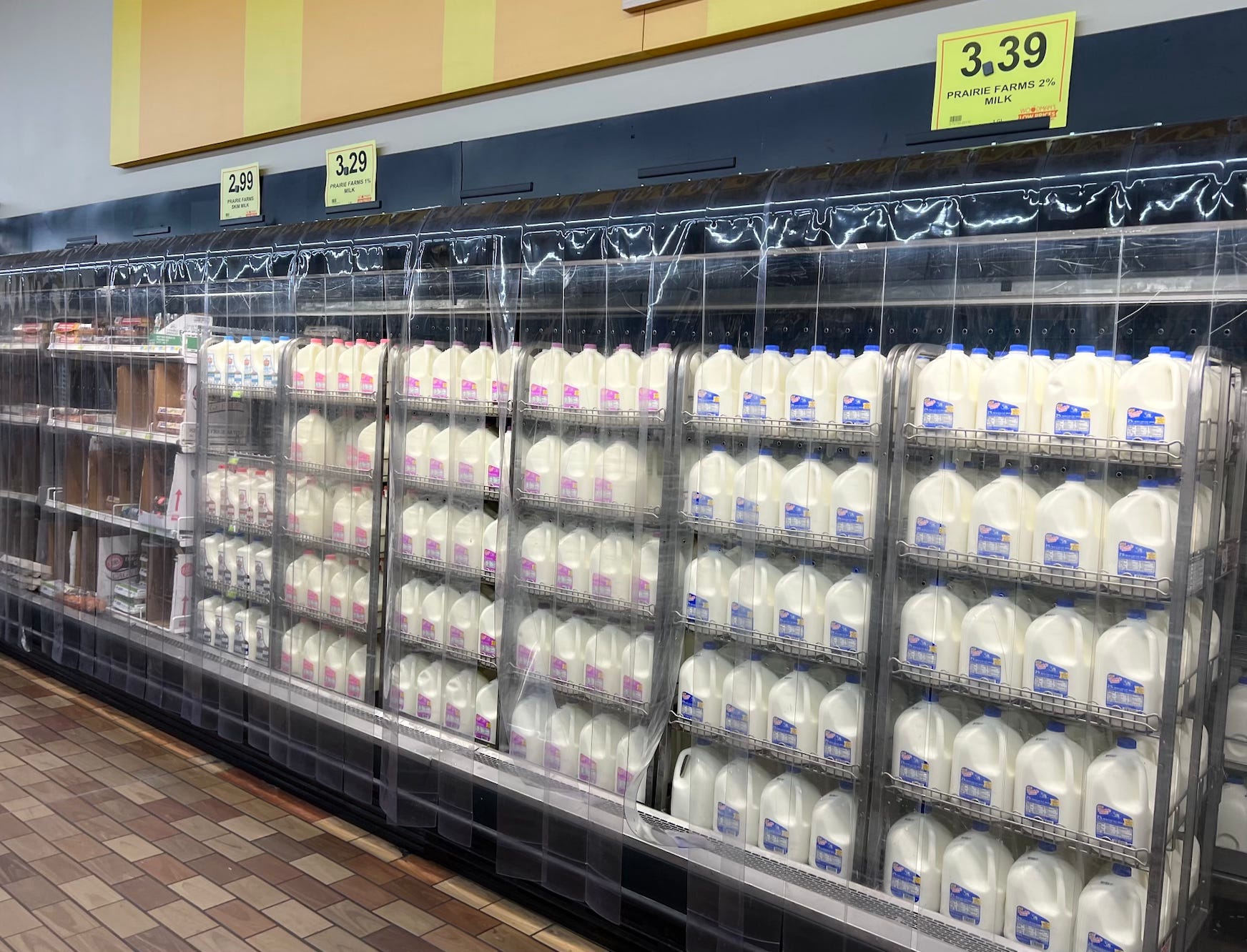
Because the price is what makes it all come together.
The employment model is employee owned but fast paced, challenging, non-union, and likely very hard to make that threshold to employee-owner, to stock and re-stock all the product all day and all night long under the watchful eye of employee-owners who want to maximize everyone’s labor productivity for the common good, a collectivized capitalism, a shared fate for all stock holders counting days until that retirement fund matures, a commodified peer pressure that retains employees and works them harder, the astronomically high dollar sales per labor hour productivity feeding into that price equation as much as the forward buy margin loving backstock inventory stacked on center store racks, the low prices on yogurt, milk, eggs, pickles, pizza, tortilla chips, stacked a mile high and a mile wide, the perspective lines stretching to imaginary horizons, a blunt force reminder that profitability is dependent on retention, loyalty and consumption rate, not rate of profit, that feeding the people is the daily, weekly, hourly priority and as an employee owned operation, the long term health of the business takes precedence over quarterly earning guillotines and shareholder payouts to BlackRock, Blackstone and black holes of Wall Street.
Capitalist?
Yes, still very much a for-profit business, privately owned, with an employee share plan spread across thousands of waged and salaried managers and workers, building middle class lives and paying mortgages and retirement plans against the momentum of a downwardly mobile, race to the bottom industry, with a CEO and a management team, watchful managers strolling the store in collared button downs, khakis and Doc Marten service shoes, checking in with employees, helping out customers, looking chill but authoritative. The many young and old cashiers and baggers timed in how fast they ring up, load up and send off each paying customer, reminding all that this is still very much a corporation, though a different, more equitable but still challenging form of American capitalism, and also a throwback to something else that maybe existed in an alternate timeline that wasn’t purely Walmart’d the fuck out everywhere, where every penny of value gets extorted out of suppliers and workers to feed the bottomless maws of the Walton Bentonville gentry trust funds. That other large-scale, diverse, efficient, fast paced but more fair and equitable industrial models of grocery could survive and thrive and point a way forward to feeding the masses.
Possibly the penultimate, most future-proofed retail template still fulfilling the original but highly imperfect promise of American industrial food, starting out with 5 aisles of bread. 5 aisles of bread.
Cheap. Convenient. Abundant. Not always healthy or sustainable. Industrial food’s heartland. Woodman’s kept the promise.
peace.
Woodman's sounds like the Chicagoland version of Boston's Market Basket!
Great article Errol! Like you prior to writing the article, I still need to hit a Woodman's though have been selling to them for years. LOVE 'THE CHECKOUT'!